Saturday, September 13, 2014

Alaska: Pretrip

I've always wanted to go fish Alaska. Finding myself day dreaming of the salmon runs with trout, grayling and arctic char gorging on salmon eggs. Being able to witness thousands of salmon come into the rivers to spawn and complete their journey on this earth while nourishing the Alaskan wildlife for the hard brutal winter just around the corner. Stepping foot on America's last frontier to chase a passion of mine that runs as deep and wild as the Alaskan wilderness. Always thinking it would be trout and salmon I would be chasing when I finally made a trip to Alaska. I'm not sure when or really how I cam across Midnight Sun Trophy Pike Adventures. It was most likely a picture of a 50" pike that I came across and started researching more about Midnight Sun. It didn't take long for me to realize how special of a pike fishery they where in the middle of.
 

After numerous correspondence through email, speaking to Scott Rowekamp (head guide and owner) and having conversations with several very satisfied and repeat anglers that have fished with Midnight Sun. It didn't take long for me to be convinced this place is the real deal. They aren't just posting pics of a few of the biggest fish taken all season, fish in the 47-50+" range are being caught weekly. Midnight Sun is not about running as many anglers as they can through their camp, they don't operate like that. They are very protective over their fishery and realize how special of a fishery they have. They practice strict catch and release with single barbless hooks and take a maximum of 6 anglers per week. All leaders are hand tied by the guides to further reduce the risk of breaking fish off and having them swim around with a fly pierced to the inside of their mouth. 

I booked my trip almost 2 years out. picking prime dates later in the season when the typically the biggest and fattest fish are caught. I knew it wasn't going to be a numbers game. Which is fine with me; I would rather catch a handful of nice fish that mean something to me then 100 cookie cutters one after another just so I can report some impressive number of fish. I normally book trips 6-9 months in advance to get prime dates, but booking a trip almost 2 years in advance was something new to me. Midnight sun books up very quickly which is testament to how good of an operation and fishery they have going. 

I've never really tied any big pike flies. I started with the basic white bunny leach with a red collar. Then started researching online for some of the bigger stuff like  Brad Bohens "Hangtime" and Blane Chockletts "T-Bone". Learned to tie a couple other flies and put the best arsenal of  Pike flies I could think of together.

I used bucktail to give the fly a little more body
and push more water. 

Lots of flies tied on Blane's Big Game Shanks.

The majority of my flies where red and white.

Time goes by fast, especially when you add a baby in the mix. Before I knew it I was buying my plane tickets and getting final arrangements lined out. About 2-3 weeks out is when things really started to slow down, time started dragging on, I was staying up till after midnight because I couldn't stop thinking of finally going to Alaska. It was starting to become real. I was spending more time on the vice, especially late at night. Not so much to crank flies out for the trip, but more to make sure I had that perfect fly that was going to catch a fish I would never forget. As time marches on and I packed everything up the night before my departure I knew this was it and I can't add any more flies to the box and there was nothing else that could be done to aid in a successful trip. The bags where packed and I went over my packing list twice. If something was forgotten I would have to live the next week without it. This is it, I'm on my way to a trip of a lifetime. 

Tuesday, September 2, 2014

Fly Fishing Offshore Series 4 of 4

This last series will consist of a few techniques used when you are fishing offshore. The most popular is probably bait and switch. This is a common technique when trolling for billfish but can be used on other fish. Its a two person technique, angler 1 will cast a piece of bait out to the targeted fish, he'll use the bait to get the fish excited and into a feeding mood. When the fish is about eat the bait, the fly angler will cast the fly towards the fish and drag it in front the fish while at the same time the angler with the bait will pull the bait away from the fish leaving the fish only the fly to eat.


Another option is chumming. Chumming with cut bait around weed beds can be very productive. Some of these weed beds can be huge and fish, especially mahi mahi are attracted to them. They also attract and hold a lot of bait fish which in the end also attracts bigger fish. By chumming around the edges of these weed beds which can be up to a football size of nothing but clumped together floating sargasum will draw any fish out from under the weed bed into casting range of the boat.

Anchoring up and chumming over wrecks and structure can also be very good. By starting a chum line behind the anchored boat the chum drifts over the underwater structure and draws fish up. It is the best way to thoroughly work over a wreck or structure. it seems we have had the best luck on king fish with this technique.

If conditions don't let you anchor the boat up the last technique is  to drift fish. This can be very good around shrimp boats. It is believed that fish will follow shrimp boats for days. So by getting behind a actively trolling shrimp boat and drifting with flies on sinking lines or drifting around an anchored up shrimp boat can be very productive. You can also drift over wrecks and underwater structure. But typically you only get one or two shots at those fish before you have drifted to far from the structure/wreck.


Friday, August 29, 2014

Fly Fishing Offshore Series 3 of 4

So what species is one most likely to catch offshore in the Gulf Of Mexico on a fly rod. You never really know what you are going to catch while offshore dredging with a heavy sink tips. It could be king mackerel, jack crevalle, red snapper, amberjack, bonito, dorado, sharks, blackfin or even yellowfin tuna and the list goes on. There is such a variety of fish you never know, and that is one of the things I like most about going offshore. We'll describe some of the more common species and a little bit about them below.

Jack Crevalle
One of the great fighters. This fish will eat anything and likes to run in schools. When they are on the hunt they move fast. They are very competitive so once a fly lands in the middle of the school they will be fighting each other to get to it. These fish can be found anywhere, in the bay, at the jetties, the surf or offshore on oil rigs and shrimp boats. After their initial run they typically go deep and the fight becomes vertical. They use there broad body to turn sideways and will fight to the end.


Bonito
Even though these fish don't get to big, they are a lot of fun with medium size gear. A 7-9 weight rod is perfect for these little 5-10 lb fish that could be referred to as blue lighting. They are fast and will fill the air with the sound every fly fisherman loves, a fly reel being lite up. 


King Mackerel
One of my favorite fish. Not to sure really what it is about this fish but I have always liked them. These fish are built like torpedo's and are one of the fastest fish in the ocean. They don't put up the best fight, they are kinda like a sprinter, they will have one good burst on the initial hook up but then after that they come in pretty easily. These can be caught off the jetties but typically you need to be in a boat to catch them. They seem to really respond well to chum slicks and can be chummed to the boat. keep your fly in the chum slick and hold onto your rod. As Capt Chip says, a bone fish will pick up your fly then accelerate to 30mph. A King will hit your fly at 30 files an hour and keep going. 


Red snapper
Probably the best eating fish there is. Also a complete pesk. These are probably the most predominate species we catch. They fight great, but catching 5-10 red snapper cast after cast gets boring after a little bit. Great fish, great fight and you should never complain about catching a fish, but when you are looking for something bigger and these fish keep taking your fly when your hoping for something else. We'll you get the point. 


Dorado
Mahi mahi, dolphin, dodos are a few names these fish go by. They are the most colorful fish in the ocean. They fight good, they jump a lot and a very good to eat. We have caught some chicken dolphin on our trips but have yet to hook into a big bull dorado. These are one of the fastest going fish and are also very short lived. They typically can be found around weed beds and other floating debris. 

Amberjack
The AJ, defiantly a fish that ranks up there with one of all time favorites. This fish can get big and are not called reef donkeys for nothing. Typically they stay deep and around underwater structure like reefs, wrecks and rocks. They are incredibly strong and do everything they can to take you into the wrecks or rocks to break you off. Like Leonidas from the movie 300 says; " Give them nothing but take from them everything!" If you want to land these fish, that's the attitude your going to have to have. 


 There is a number of other species offshore like blackfin and yellowfin tuna, which I hope to put a trip together out of Venice La for next year. There's also cobia which we have caught on bait but had a hard time getting them to take flies, even though I know they will. We've caught some smaller sharks on the fly, but I don't really care to tangle with them on the flyrod. Now if its a mako I'm all game, but blacktips and bull shark don't excite me that much. There's some sails and a few marlin in the Gulf but its not a place you really want to spend specifically targeting them.

Sunday, August 24, 2014

Fly Fishing Offshore Series 2 of 4

This series will consist of the flies I like and how I normally rig up my leaders and wire bite tippet. Its relatively simple and I like to use the KISS principle. By Keep It Simple Stupid you make things easier on yourself, easier and faster to re-rig your gear and get your fly back in the water.

Gammy's SL12S AKA Trey Combs Hooks are a great 
blue water hook. 


To start off my leaders are very simple. My leaders are not setup for IGFA flyfishing rules, but I've never had any intention of putting a fish in the record books. So depending on the rig and what I am fishing for depends on how I'm going to rig up. In my opinion the best flourocarbon is Seaguar leader material and it is what I use for all my leaders. On my TICR 10wt I like to start off with about 6' of 30 lb flouro, I then put a loop on each end. The loop knot I'm using is a perfection loop. At the end of the loop I attach roughly 3-5 inches of 40lb wire. I like the silver/gray wire with a clear nylon coating, TyGer wire and AFW Surflon wire. The 10wt is always rigged with a chartreuse/white clouser tied with the 5/16" IBalz. These eyes are very heavy and are ideal for getting to the 10-40 foot depth.

I always like to have several flies rigged up with the wire already attached 
so all I have to do is loop it onto the leader to get back to fishing.

The TFO Mini Mag is rigged with 90 lb flourocarbon butt section to a 50lb bite tippet. This rig is setup for  topwater flies like Bob Popovics  Banger.

Bangers in white and white/pink are great topwater flies.

The 12wt TICRX  is rigged with about 6' of 50lb flourocarbon with a loop knot to attach to 5-6" of wire bite tippet. This rig is set up for large kings in mind and I like to have it rigged up with a tubefly. Bill and Kate Howe make some great bluewater tube flies.

To add some more weight to your fly to handle current or get it deeper
thread on a bullet weight. Carry various sizes to handle different 
depths and current speeds.

The TFO blue water rod is rigged with 6' of straight 90lb florucarbon. Not much to it, this rod is setup to put serious heat on big fish like amber jack, tuna, cobia and the like. Most people don't realize how much pressure you can put on a fish with a flyrod, the TFO blue water rod is a pool cue for a reason.

These fish are strong, especially when you are trying to pull them away from
a wreck or underwater structure. Not very often a fish breaks the 
point off a heavy gauge hook like a Mustad 34184.
     

Tuesday, August 12, 2014

Fly Fishing Offshore Series 1 of 4

I'm starting a new series that will consist of fly fishing offshore; particularly fishing in the Gulf of Mexico off the Texas coast. This will be a four part series with the first series covering rods, reels and lines. Followed by three other series that will consist of flies and rigging, the fish and lastly techniques.

Series 1: Flys, Reels and Lines

There are four rods I like to take offshore with me. I will explain each rod and what reel and line I have matched it up with.

The first rod is a TFO Mini Mag 8-10 wt rod. This 8’ rod utilizes Temple Fork’s Bluewater Technology; a hybrid combination of S-Glass and high-modulus carbon fiber. With exceptional lifting power and casting ability the 3-piece Mini Mag goes through TFO’s proprietary TiCr coating process twice. This process adds exceptional power and durability to the rod. The rich blue granite finish on this rod looks great chasing fish in the bluewater. This is the only rod I have setup with a floating line. I have rigged it up with a 10wt RIO Outbound Short.. With a short, aggressive front taper this line is designed to cast large and heavy flies. The powerful head design loads rods deeply and efficiently for easy casting. This line and rod is perfect for casting medium sized poppers like Mr. Popovics "Bob Bangers". The reel I have on this rod is a Ross F1 in size 5. This is a great reel utilizing eight independent contact points to produce a smooth and dependable drag. Incorporating two square inches of carbon fiber drag surface has resulted in a reel with unsurpassed stopping power. This setup is ideal for throwing poppers around shrimp boats, weed lines, and when the birds and fish are on bait balls.

My next setup is a TFO TiCr 10wt. This 9' rod is the rod I primarily use. Unfortunately TFO has discontinued this series. The rod has a great backbone and there isn't a better all around rod for fishing offshore. I have a Ross Momentum 6 on this rod. The Momentum is one of the strongest and most dependable big game fly reels on the water today. Using carbon fiber based technology for the drag including three backup systems to ensure dependability under the most critical fishing conditions, it is one of the ultimate big fish fly reels. This rod is also lined up with the RIO Outbound. The over all line length is 120' with a 37.5'  type 6 DC sinking head. With an intermediate running line this line can get your fly down quick. This setup is ideal for fishing 30'-50' of water with a large clouser.

The third setup is a TFO TiCr X 12wt. Also being 9' this rod has just as much backbone and a little stouter tip. The power in the TiCr X gives this rod the ability to not only cast heavy grain sink tips, but also larger flies and more importantly lift angry fish from the depths. The reel I paired up with this rod is the Colton Torrent 1113. This fly reel was designed to put some serious heat on a fish. Producing 12lbs of drag out of the box the Torrent can be modified at the factory to exceed 18lbs of drag. Bring on the Tuna, Billfish and Sharks because this reel can handle the challenge. A strong rod and reel needs a strong line. RIO's Leviathan series of lines have been specifically designed to target big fish. I am throwing the 600 grain series. This line is built on a ultra strong 70 lb core that will hold up to the hardest running fish in the ocean.

The last rod in my offshore arsenal is the TFO Bluewater in the medium duty series. This 8-6' rod goes through the TiCr coating process twice. A hybrid S-glass in combination with IM6 graphite and a fore grip, this rod is built for battle. Teamed this heavy weight rod up with a Ross Momentum # 7. With its carbon fiber rulon drag with triple redundancy radial pawl engagement there is seamless transition between line-in and drag engagement. With no start up inertia this reel is also built for battle. I spooled this reel with 500 yards of 80lb Power Pro and Airflo Depth Finder 700 grain Big Game line. This line is built for getting deep with 120' of intermediate running line and a 30' 700 grain head this line isn't called Depth Finder for nothing. it has a 50lb low stretch core to maximize hook setting power at any depth. This rig is setup for dropping the heaviest flies to deep underwater structure looking for amberjacks, snapper and other deep water structure oriented fish.  

The write up looks bare with out any pictures. I was thinking of adding some, but I don't have any neat pics of my rigs setup and ready for action. I guess we have all seen a rod and reel so its not that big of a deal. One think I will add is all my reels are setup with power pro backing. I use the 80lb spec and will go more into backing in the next series.

Monday, August 4, 2014

Annual POC Trip

Scott and I had a great weekend fishing offshore this year with Capt. Steve Barnes. This years main goal for me was to get a amber jack on the fly rod, and Scott wanted to get into more dolphin. We got down into Port O'connor late Friday afternoon. After getting checked into the motel and unloading the truck we grabbed some good mexican food at one of the local restaurants. After eating to much we returned to out motel room and started putting our gear together for morning. The morning started off with some clouds and storms in close, we decided to punch through them and get offshore. The morning kinda started off a little slow because of the rain and storms. The first shrimp boat we stopped at I hooked up with a king fish right off the bat, but after that it was dead and we decided go out a little farther to get out of the rain. We stopped at a weed line and Scott was able to find a dolphin. After a sweet jump on the initial hook up the fish went deep. A few minutes later Scott got him in the boat. We had a few more swimming around but I wasn't able to hook up with any of them.

After going out a little further we started drifting over some rocks in 170 feet of water. Yes you can catch fish that deep on a fly rod. It has to be specifically designed to get that deep. But is is very doable. First drift over the rocks I hooked up with this reef donkey. These fish are incredible strong and you can't give them anything or they will break you off in the rocks.   


#2 of 3 Amberjack for the day. I probably could have caught more but those fish will kick your ass. I had to rest a few minutes between each fish.  

Scott with a nice red snapper. We caught many in the 10lb range.

Scott with his AJ. 

Day 2 started off great. We patrolled the beach front almost all day trying to get into some tarpon. We say plenty of tarpon but just couldn't convince any to bite. There was so much bait in the surf that I think the fish just had to many options that morning. 

Scott Caught a nice shark on a coon pop we 
were trolling behind the boat. 

 We caught some lady fish, gafftops, and small jacks on the long rods while trying to get into some tarpon. It just never happened. You couldn't have asked for better conditions to fish the beach front. I guess it just wasn't our day. In the coming weeks I'm going do a few blog post on the gear I use when fishing offshore. If yall have any questions I will try to answer them in the post. Let me know if there is anything specific you have questions on. 


Putting the TFO Bluewater to the test. 

Putting the heat on an amberjack.

One of many nice Red Snapper caught. 

Saturday, July 19, 2014

Anvil

Here is a new fly I have been working on. The primary purpose for this fly is to get as deep as possible and as quickly as possible. This fly is tied with a 1oz tungsten weight and will need a 500-750 grain sink tip to cast. It is tied on a 4/0 Mustad 60degree jig hook. Its will be used to target deep water fish off of shipwrecks, oil rigs and other deep open water structure that hold fish like Amberjacks, Grouper, Snapper and so fourth in 60-90 feet of water. You can easily down size this fly and still have a fly that rides hook point up and has a great jiggy action.

Shipwreck'd

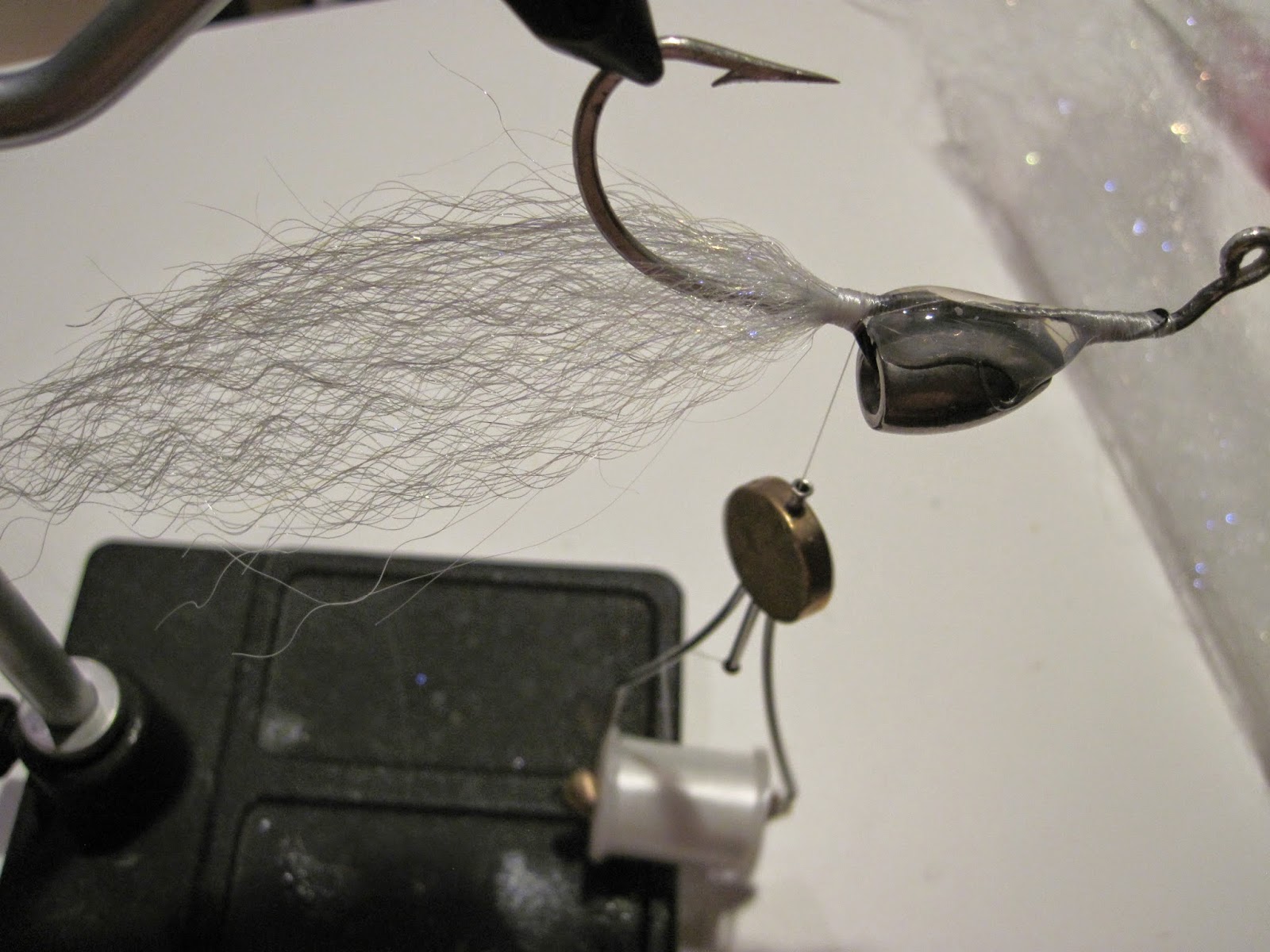
Start off with a 60degree jig hook.

Run a piece of wire through the bullet weight and 
secure to the hook shank.

I like to add some glue to keep the weight from
rotating around the hook shank.

Tie in some SF Flash Blend using a V tie technique.

Tie in tome more in front of the weight. Make sure to
use enough material to cover around the weight.

Use some glue to hold the fibers around the weight.

Goop has become one of my favorite glues recently
to use to secure eyes and other processes in 
fly tying. Its cheap and can be
 found almost anywhere. 

Tie in some EZ body.

Fold the EZ body back over itself to 
cover up the weight.

Go ahead and tie off the EZ body

Take your second color, this color just needs to
extend past the bend of the hook. 

Move up the hook shank and tie one more set
of SF Flash Blend. Take some scissors and 
trim the fly to shape. Glue in your eyes.
and your done.  

Shipwreck'd